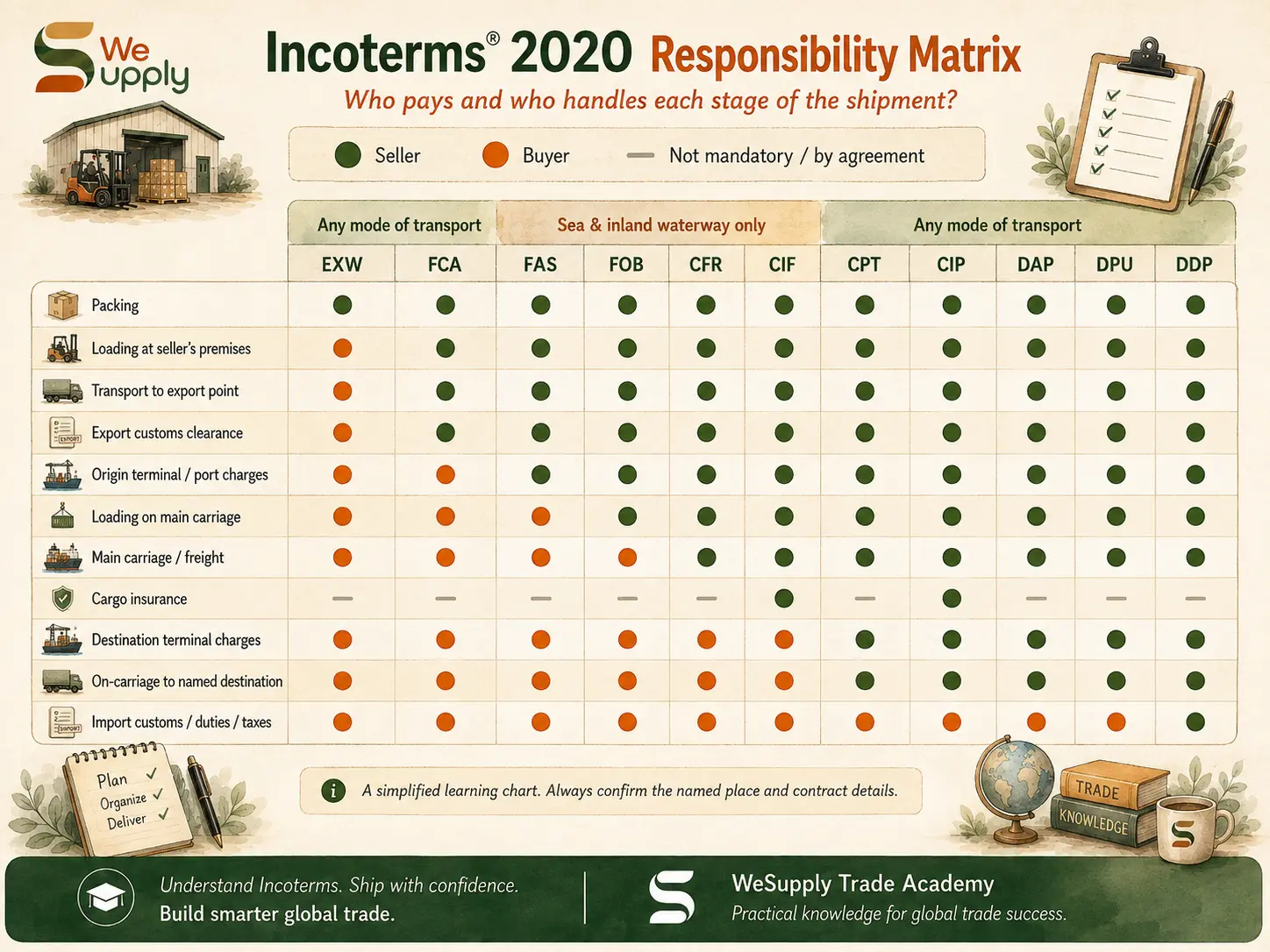
Incoterms Explained: A Simple Guide for International Trade
Incoterms are 11 internationally recognised trade rules that define who pays for shipping, insurance, customs, and risk between buyer and seller in international transactions.
International shipping involves more than moving goods from one country to another. Buyers and sellers must also decide who will arrange transportation, complete customs procedures, pay duties, provide insurance, and carry the risk if the goods are lost or damaged. This is where Incoterms® become important.
Incoterms are internationally recognised trade rules that clearly divide shipping costs, risks, and responsibilities between buyers and sellers. Using the correct Incoterm can prevent misunderstandings, reduce unexpected costs, and make international transactions more efficient.
What Are Incoterms?
Incoterms stands for International Commercial Terms.
They were first introduced by the International Chamber of Commerce in 1936 to create a common language for global trade. Without standardised terms, companies in different countries might interpret delivery responsibilities differently.
For example, a buyer may assume that the seller will pay import duties, while the seller may believe those costs belong to the buyer. Incoterms help prevent this type of misunderstanding.
They clarify:
- Who arranges and pays for transportation
- Who handles export and import customs clearance
- Who pays duties and taxes
- Whether the seller must arrange cargo insurance
- Where the goods must be delivered
- When the risk transfers from the seller to the buyer
The latest version is Incoterms® 2020, which includes 11 rules.
Main functions of the Incoterms:
- Standardisation: Ensures all parties are on the same page regarding terms and conditions.
- Cost allocation: which contract partner bears which costs?
- Division of obligations: which contract partner takes on which obligations on which route?
- Risk transfer: which contract partner covers which risk at which moment in time?
- Improved communication: Facilitates better communication and understanding between international trade partners.
Other functions of the Incoterms:
- Goods documents: which contract partner buys the required goods documents?
- Customs: which contract partner is responsible for customs clearance?
- Transport documents: which contract partner buys which transport documents?
- Shipping insurance: which contract partner insures the goods for which part of the transport?
- Information: which contract partner informs the other at what time and about what?
- Goods inspection: which contract partner carries out the goods inspection?
Why Is the Risk-Transfer Point Important?
One of the most important differences between Incoterms is the point at which risk transfers from the seller to the buyer. From that point onward, the buyer carries the risk of loss or damage to the goods. However, the transfer of risk and the payment of transportation costs do not always happen at the same location.
Incoterms provide a clear framework for international shipments. They define who pays, who manages each stage, and when the risk transfers from the seller to the buyer.Choosing the right Incoterm can reduce uncertainty, improve supply-chain planning, and protect both parties during an international transaction.Before confirming an order, make sure the selected Incoterm is clearly written, includes an exact location, and is understood by both the buyer and seller.